



Onshore Plastic Molding to the U.S.? Local Manufacturing has Benefits
December 3, 2024
How Precision Molding Scales to Regulated Markets
February 6, 2026
Whether engineering a medical device, aerospace assembly, industrial system, or consumer product, bringing a new plastic component to your market requires much more investment that simply selecting a material and commissioning a mold. Successful OEMS understand that the earlier the engineering team engages with their molder, the smoother the entire operation will be from conception to production.
Davies Molding knows that early engineering collaboration isn’t a value-added option. It’s the foundation that ensures customers avoid late-stage surprises, reduce tooling rework, accelerate timelines, and achieve high-performance molded parts for scalable manufacturing.
Early Design Input Improves Manufacturability
The number one hidden cost in plastic component development is preventable redesign. Bringing molders in after the design is finalized can lead to the discovery of many issues that were invisible onscreen but obvious to a manufacturing engineer.
These issues can include:
- Undraftable walls
- Poor rib-to-wall ratios causing sink
- Sharp corners that risk cracking
- Geometry incompatible with thermoset flow
- Underestimated tolerances
- Features that require complex, costly tooling inserts
Once tooling begins, every avoidable change becomes more expensive and time consuming.
Through our Design for Manufacturability (DFM) at the concept stage, Davies engineers can address these challenges up front. We utilize advanced CAD modeling, 3D analysis, and reverse engineering capabilities to help customers design it right before committing to steel.
Through this method, this leads to:
- Optimized part geometry
- Reduced material waste
- Lower cycle times
- Better surface finishes
- Longer-lasting tools
Partnering with Davies early eliminates the costly loop of:

Early Collaboration Reduces Tooling Iterations & Speeds Time-to-Market
Tooling is one of the most significant investments in custom moldingg. Changes are difficult once a mold is cut. Sometimes, it’s impossible to cut without starting over.
Davies minimizes tooling iterations by integrating engineering feedback before, during, and immediately after the design phase. Built on decades of hands-on experience in both thermoset and thermoplastic mold construction, our in-house tooling teams work to ensure that the final mold aligns precisely with the part’s functional requirements.
We validate the design early through prototyping, sampling, and process development. This prevents downstream delays, such as:
- Mold rework
- Gating or venting corrections
- Filling defects
- Short shots or flash
- Warpage and dimensional instability
We shorten the overall development cycle because we manage tooling, molding, and secondary operations all under one roof. This gives OEMs a faster path to launch.
Material Guidance that Mitigates Risk from the Start
Wrong materials can derail a project late in the game. Choices regarding strength, temperature resistance, chemical exposure, fatigue, cost, and regulatory compliance all can influence whether a component will succeed in the field.
Engineers at Davies bring deep expertise in BMC, SMC, epoxies, phenolics, polyesters, engineering-grade resins, and commodity thermoplastics to ensure that our customers select materials that support both performance and manufacturability.
Early guidance can prevent issues, such as:
- Failures due to incorrect resin selection
- Excessive part shrinkage
- Delamination or brittleness
- Premature tool wear
- Avoidable compliance or testing issues
Material selection is important; it’s not a late-stage decision. It affects tooling design, part geometry, and production processes. With Davies’ early involvement, we safeguard the design from preventable performance risks.
Early Engineering Input Improves Cost Control Throughout the Lifecycle
Cost discipline can’t be left to the end of the project. It has to be engineered in from the beginning. Davies helps evaluate part geometry that reduces material usage and tooling construction that minimizes maintenance. We offer several manufacturing methods, such as injection vs. compression vs. transfer, and we also offer secondary operation requirements.
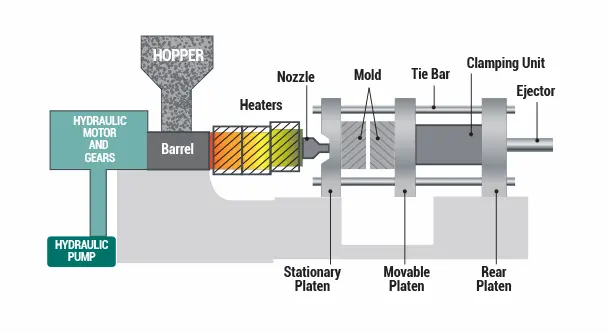
With over 71 molding machines ranging from 25 to 500 tons and a full suite of compression, transfer, and injection molding capabilities, Davies provides cost-optimized solutions tailored to volume, performance, and design complexity.
Our early insight prevents the need for unplanned budget increase later, especially with those resulting from incorrect assumptions about tooling design or manufacturing methodology.
Reducing Late-Stage Surprises with Prototyping, Sampling, & Process Development
Prototypes, from a sketch to a digital model to a finished part, bridge the gap between concept and manufacturable reality. Our engineering team supports a variety of methods, including 3D printed prototypes, pre-production samples, tool sampling, early process development, and validation testing.
This is a critical stage for identifying potential issues before they escalate into production roadblocks. We emphasize these in-between checkpoints as part of our concept-to-production engineering support, allowing customers to refine parts intelligently.
The more time engineers have to test and iterate, the more predictable the production process becomes.
Integrated Capabilities Reduce Risk by Eliminating Handoffs
Davies Molding works together with Versatile Mold & Design to provide complete lifecycle support, from design and tooling through molding, finishing, assembly, and packing.
This reduces project complexity by:
- Keeping design intent consistent
- Ensuring tooling matches the engineering model
- Streamlining quality control
- Allowing quicker adjustments
- Maintaining visibility across all stages
OEMs gain a single accountable partner who can manage everything from idea to production-ready components while minimizing uncertainty and accelerating deliverables.
Engineering-Led Manufacturing Prevents Problems Before They Start
At Davies, we don’t just build what we’re given. We do far more.
We anticipate manufacturability challenges while guiding design choices that improve part performance from the get-go. We work to ensure that the material tolerances align with real-world molding behavior. While we’re building high-quality molds that product consistent parts, we’re also creating a roadmap for scalable production.
Our engineering teams rely on extensive CAD/3D modeling, reverse engineering tools, scanning technology, and manufacturing insight to create a seamless transition from design to production.
Early Engineering is the Competitive Advantage
OEMS across demanding industries trust Davies Molding for a reason: engaging our engineering team early means projects run smoother, tools last longer, parts perform better, and launches happen faster.
By aligning design, engineering, tooling, and production from the beginning, Davies eliminates avoidable issues that cost time, money, and market opportunity.
Early collaboration reduces:
- Cost with fewer redesigns, optimized tooling, and efficient processes
- Time with accelerated prototyping, faster tooling approval, and streamlined production
- Risk with better material selection, manufacturability assurance, and quality consistency
When the stakes are high and timelines matter, engineering-led guidance isn’t optional, it’s transformative. Start your project with Davies Molding today.