

Highly regulated sectors such as medical devices or aerospace parts are often associated with specialized manufacturers and strict processes. In actuality, the foundational requirements of these industries are process control, repeatability, documentation, and material traceability. These are not exclusive to regulated markets. They’re the same fundamentals that define best-in-class industrial manufacturing.
Davies Molding serves demanding industrial, infrastructure, and OEM customers with decades of experience. Our manufacturing systems align with the expectations of regulated environments. The difference isn’t a dramatic reinvention; it’s the scaling and forma lization of proven precision molding practices.
That’s how Davies’ existing capabilities naturally extend from heavy-duty industrial applications into medical, aeropace, and other regulation-driven markets.
Precision Manufacturing Is the Common Denominator
Whether producing a structural electrical component, an aerospace housing, or a medical enclosure, the core requirements remain the same. There needs to be tight dimensional tolerances, consistent material performance, repeatable production results, and predictable process behavior.
Failure is not an option. Davies has long operated under this core belief. Industrial and infrastructure customers depend on molded components that withstand heat, vibration, electrical load, chemical exposure, and long service lives. Process disciple and engineering rigor are keys to meeting these conditions, just as regulators expect in professional manufacturing.
Precision molding is not a market-specific capability. It’s a manufacturing mindset.
Certified Processes That Support Regulated Requirements
One of the most critical factors in regulated markets is confidence in the manufacturing process itself. Regulators, auditors, and OEM quality teams expect documented, controlled, and repeatable processes that reduce variability and risk.
A trusted partner operates with manufacturing systems that are built around defined process parameters, controlled molding environments, documented tooling and setup standards, statistical process monitoring, and formal inspection and validation practices. That’s Davies in a nutshell.
These frameworks support qualification, validation, and audit readiness without requiring manufacturers to reinvent their operations when entering regulated markets.
Instead of addressing compliance issues at the later stages of a project, Davies embeds process discipline from the initial design phase all the way through to production. This approach guarantees consistent quality, regardless of whether the component is intended for an industrial control system or a medical device assembly.
Consistency and Repeatability at Production Scale
In regulated markets, repeatability is not optional. Producing one conforming part is insufficient; manufacturers must demonstrate the ability to produce thousands, even millions, of identical parts with predictable results.
This requires manufacturers to operate with stable tooling platforms designed for long production runs and repeatable machine setups across multiple presses. Controlled material handling and conditioning along with standardized inspection checkpoints are also required.
With a wide range of molding technologies at hand, including thermoset compression, transfer, and injection molding, Davies supports applications where dimensional stability, mechanical performance, and cosmetic consistency must remain intact over time.
This ability to scale without introducing variation is a cornerstone of both regulated manufacturing and high-reliability industrial production.
Material Expertise and Traceability Built In
Material selection is one of the most scrutinized aspects of regulated manufacturing. High demanding customers require the right material and, more importantly, clear traceability from raw materials to the finished part.
From engineering-grade thermosets like phenolics, epoxies, and polyesters to application-driven thermoplastics, Davies’ extensive experience allows the engineering team to guide material decisions based on performance, manufacturability, and compliance requirements.
Additionally, Davies’ production controls support material traceability through lot tracking and documentation, controlled material storage and handling, and process records tied to specific material batches. This ensures accountability, simplifies audits, and supports customer documentation requirements.
Engineering-Led Design Reduces Regulatory Risk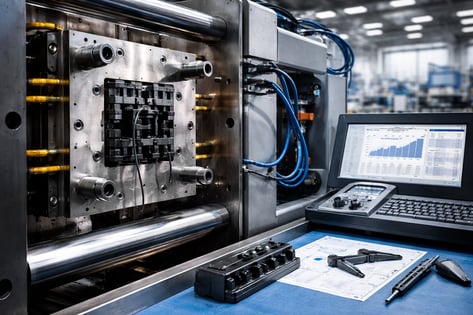
Predictability is compliance in regulated markets. Predictability starts with engineering.
Early design choices in regulated markets may result in expensive or irreversible consequences later on. If a product is not designed with manufacturability in mind, it can cause problems like uneven filling, structural weaknesses, visual flaws, or unstable dimensions, all of which can increase regulatory risk.
Davies’ engineering-focused strategy reduces regulatory risks by evaluating whether part shapes can be manufactured, matching materials to their intended uses, creating tooling that ensures even filling and cooling, and planning for variations in tolerances and performance. Involving manufacturing engineers early in the design process is how Davies helps customers avoid late-stage changes that led to project delays.
Tooling Built for Validation and Longevity
Tooling quality directly impacts process stability. In high-demanding industries, tooling must support not only the part quality, but also validation and long-term repeatability. Davies’ in-house tooling capabilities are proof that expertly engineered and maintained tools are essential for delivering consistent, compliant, and reliable molded components across both regulated and industrial markets.
Because Davies integrates tooling, molding, and secondary operations, we maintain full visibility into how tooling decisions affect production behavior. This integration is critical when parts must meet documented performance criteria over extended lifecycles.
Inspection, Documentation, and Quality Culture
Regulated markets demand more than good parts. They need proof. Documentation, inspection records, and quality controls must demonstrate that each process is under control, and outputs meet specifications.
Davies’ quality systems emphasize defined inspection plans, first-article and in-process verification, dimensional and visual consistency checks, and documentation aligned with customer requirements. This quality culture supports seamless collaboration with regulated OEMs, contract manufacturers, and quality teams. This ensures that compliance expectations are met without slowing production.
Scaling into Regulated Markets Without Reinventing the Factory
The misconception that regulated manufacturing requires an entirely different type of supplier often leads OEMs to overlook highly capable industrial manufacturers. In reality, Davies Molding’s long-standing strengths of precision, repeatability, engineering discipline, and material expertise are exactly what regulated markets demand.
What changes is not the foundation, but the degree of documentation, validation, and oversight layered onto an already robust manufacturing system.
Built for Reliability, Ready for Regulation
From heavy-duty industrial components to precision-crafted medical components to high-quality aerospace parts, the path to regulated manufacturing is built on fundamentals. There’s no room for shortcuts.
Davies Moldings’ certified processes, consistent production systems, material traceability, and engineering-led approach create a natural bridge into regulated markets. These capabilities aren’t new or groundbreaking. They’ve been refined over decades of serving customers who rely on performance, reliability, and accountability.
For OEMs seeking a molding partner that understands both industrial rigor and regulatory expectations, Davies offers a proven foundation that confidently and compliantly scales into the most demanding markets.


