


Common Challenges in Plastic Injection Molding and How to Overcome Them
September 21, 2026
Material selection is one of the most important decisions in custom plastic molding, yet it is often treated as a secondary consideration during product development. Engineers may begin with a component’s geometry, functional requirements, or cost targets, assuming the appropriate material can be selected once the design is more fully developed.
Unfortunately, this approach can introduce significant manufacturing challenges, increase project costs, and compromise long-term product performance.
The reality is that material selection should happen early in the custom molding process, ideally before part geometry is finalized and production tooling is designed. Every material behaves differently under heat, pressure, mechanical stress, and environmental exposure.
Those characteristics influence not only how a component performs in the field but also how it must be designed, molded, and manufactured.
At Davies Molding, early engineering collaboration helps customers evaluate material options before critical design and tooling decisions are made.
With experience in thermosets, thermoplastics, and reinforced molding compounds, Davies helps manufacturers select materials that balance performance, manufacturability, cost, and long-term reliability.
Why Material Selection Should Begin During Product Design
A material that looks suitable on a technical data sheet may not be the best choice for a particular molded component.
Material properties must be evaluated alongside the component’s intended application, operating environment, geometry, production volume, and manufacturing process.
For example, a resin may offer excellent mechanical strength but exhibit shrinkage characteristics that make tight dimensional tolerances difficult to maintain. Another material may withstand elevated temperatures but require specialized tooling, longer processing cycles, or additional finishing operations.
When these considerations are discovered late in development, manufacturers may face costly design revisions or tooling modifications.
Selecting materials early allows engineers to address potential conflicts while the design is still flexible. Wall thickness, ribs, bosses, tolerances, and other features can be optimized around the chosen material rather than forcing a material to work within an already finalized design.
The earlier material decisions are made, the greater the opportunity to improve both component performance and manufacturing efficiency.
Evaluating Performance Requirements Before Material Selection
Effective material selection begins with understanding what the finished component must accomplish.
A molded part may need to withstand substantial mechanical loads, resist aggressive chemicals, maintain electrical insulation, or perform under continuous exposure to elevated temperatures.
Engineers should evaluate several critical factors.
Mechanical Strength and Fatigue Resistance
Components subjected to repeated loading, vibration, or impact require materials with appropriate strength, stiffness, toughness, and fatigue behavior.
A material that performs well under a single static load may not provide adequate durability when exposed to thousands of repeated loading cycles.
Temperature Resistance
Operating temperature can influence strength, stiffness, dimensional stability, and long-term material performance.
Thermosets may offer advantages in applications requiring thermal stability, while certain engineering thermoplastics can also provide excellent high-temperature performance.
The correct selection depends on the temperature range, exposure duration, and mechanical requirements.
Chemical and Environmental Exposure
Oils, solvents, cleaning agents, moisture, ultraviolet radiation, and other environmental factors can affect material properties.
Selecting a resin without considering these conditions may result in swelling, cracking, degradation, or premature component failure.
Regulatory and Industry Requirements
Medical, aerospace, electrical, and other demanding applications may require specific material properties, traceability, testing, or regulatory documentation.
Identifying these requirements early helps prevent late-stage compliance issues and unnecessary material changes.
Cost and Production Requirements
Material cost is only one part of the equation.
Processing time, tooling requirements, scrap rates, secondary operations, and expected production volume all influence the total cost of manufacturing a component.
Thermoset vs. Thermoplastic: Choosing the Right Material Family
One of the earliest decisions in custom molding is determining whether a thermoset or thermoplastic material is better suited to the application.
Thermoset Materials
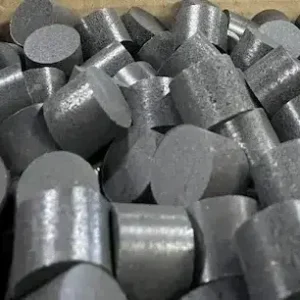
Thermosets undergo a chemical curing reaction that creates a permanent crosslinked molecular structure. Once cured, they can’t simply be remelted and reshaped.
Depending on the formulation, thermosets can provide valuable combinations of thermal stability, mechanical strength, dimensional stability, electrical insulation, and chemical resistance.
Davies has extensive experience with thermoset molding, including the following materials:
- Phenolics: Often selected for electrical insulation, heat resistance, and dimensional stability.
- Bulk Molding Compound (BMC): Reinforced compounds commonly used for complex electrical, structural, and industrial components.
- Sheet Molding Compound (SMC): Frequently used for larger reinforced components requiring structural performance.
- Epoxies: Formulations that can offer strong electrical, mechanical, and chemical-resistant properties.
- Polyesters: Used in various reinforced molding compounds for industrial and structural applications.
Thermoplastic Materials
Thermoplastics soften when heated and solidify when cooled, allowing them to be processed through injection molding and other manufacturing methods.
Commodity thermoplastics can provide economical solutions for many applications, while engineering-grade resins offer enhanced mechanical, thermal, chemical, or dimensional performance.
Material selection should consider the required properties alongside processing behavior, production economics, and the component’s expected service conditions.
Davies has experience with thermoplastic materials, including:
- ABS: Often selected for impact resistance, toughness, dimensional stability, and ease of processing in housings, enclosures, and industrial components.
- Polycarbonate: Offers excellent impact resistance, strength, heat resistance, and dimensional stability for electronic components in demanding industrial applications.
- Polypropylene: Frequently used for containers, automotive components, and living hinges due to its chemical and moisture resistance and fatigue performance.
- Nylon: Known for its strength, wear resistance, toughness, and low-friction properties. It is commonly used for gears, bearings, fasteners, and other mechanically demanding components.
Neither material family is universally superior. The correct choice depends on the application.
How Material Selection Influences Mold Design
Material selection and tooling design are closely connected.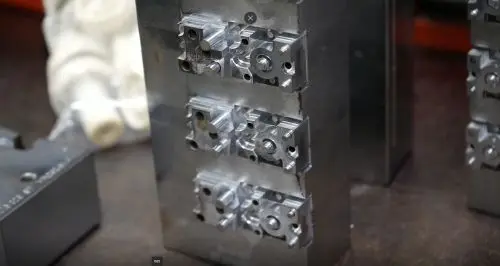
Different materials have different shrinkage rates, flow characteristics, processing temperatures, reinforcement levels, and wear behavior. These properties directly influence how a mold must be engineered.
For example, material shrinkage affects cavity dimensions and the ability to maintain tolerances. Reinforced compounds may require additional consideration of flow orientation, abrasive wear, and high-contact tooling surfaces.
Material viscosity and flow behavior influence gate placement, runner design, venting, and the ability to fill complex features.
Thermoset materials introduce additional considerations involving cure time, temperature uniformity, charge placement, and flash management.
Selecting a material after tooling has been designed can create serious complications if the original mold architecture is incompatible with the new material’s processing requirements.
Early material guidance helps ensure that the component, mold, and manufacturing process are engineered together rather than developed independently.
Preventing Manufacturing Problems Through Early Material Selection
Selecting the wrong material can create problems that don’t become apparent until mold sampling, production, or field use.
Early material evaluation helps reduce several common risks.
Excessive Shrinkage and Warpage
Materials respond differently to cooling, curing, and reinforcement orientation. Inappropriate material selection can contribute to dimensional instability, warpage, and difficulty maintaining critical tolerances.
Understanding shrinkage behavior early allows engineers to optimize geometry and tooling accordingly.
Delamination and Brittleness

Certain reinforced compounds may experience delamination, cracking, or brittle failure when material selection, geometry, processing conditions, or environmental exposure aren’t properly considered.
Evaluating these risks during development helps engineers select materials that support the required mechanical performance.
Premature Tool Wear
Highly filled or glass-reinforced materials can be abrasive.
If reinforcement characteristics aren’t considered during tooling design, wear may occur prematurely around gates, shutoffs, cavities, and other high-contact surfaces.
Early selection allows the tooling strategy to account for appropriate steel grades, surface treatments, and replaceable wear components.
Material-Related Performance Failures
A component may pass initial inspection but fail after prolonged exposure to heat, chemicals, mechanical stress, or moisture.
Early material guidance helps ensure that the selected compound is evaluated against actual service conditions rather than nominal specifications alone.
Avoidable Testing and Compliance Issues
Late discovery of material documentation, flammability, electrical, or regulatory requirements can force additional testing or redesign.
Addressing these requirements during material selection can help streamline validation and reduce development risk.
Material Selection Is a Critical Part of Design for Manufacturing
Design for Manufacturing (DFM) evaluates whether a component can be produced reliably, efficiently, and at the required quality level.
Material selection is foundational to this process whether the part needs to be injection or compression molded.
During DFM, engineers assess how the proposed material interacts with:
- Wall thickness and geometry
- Draft angles and part release
- Undercuts and mold complexity
- Gate and material-flow strategies
- Parting-line placement
- Shrinkage and dimensional tolerances
- Cooling or cure requirements
- Ejection and secondary operations
- Production volume and cycle time
A design that’s manufacturable in one material may require significant changes when produced using another.
By addressing material selection during DFM, manufacturers can identify opportunities to simplify tooling, improve process consistency, and reduce unnecessary production costs.
The Long-Term Cost of Choosing the Wrong Material
The consequences of poor material selection extend beyond initial tooling or development expenses.
An unsuitable material may increase cycle times, scrap rates, maintenance requirements, inspection costs, or secondary processing needs. More serious problems can include field failures, warranty claims, product recalls, and production interruptions.
Conversely, selecting the appropriate material early can improve long-term manufacturing economics. A material with a higher initial purchase price may provide better dimensional stability, longer service life, reduced processing waste, or fewer secondary operations.
The most economical material isn’t necessarily the least expensive resin. It’s the material that delivers the required performance at the lowest practical total manufacturing cost.
How Davies Molding Helps Customers Select Materials Early
Successful material selection requires more than comparing resin specifications.
It requires understanding how materials behave during molding and how those characteristics affect the finished component.
Davies Molding brings experience across BMC, SMC, epoxies, phenolics, polyesters, engineering-grade resins, and commodity thermoplastics to help customers evaluate material options early in development.
By collaborating with customers before tooling begins, Davies can help assess application requirements, identify potential material-related risks, evaluate manufacturing processes, and recommend design considerations that support reliable production.
This early involvement helps connect material selection with DFM, tooling development, molding operations, and long-term production requirements.
Rather than addressing problems after they appear, Davies works to identify potential challenges while meaningful design changes are still possible.
Make Material Selection an Early Engineering Decision
Material selection should never be an afterthought in custom molding.
The material chosen during product development influences nearly every subsequent decision, from part geometry and tooling design to processing conditions, dimensional accuracy, production efficiency, and long-term component performance.
Making that decision early gives manufacturers more flexibility to improve designs, reduce manufacturing risk, and avoid costly changes later in development.
Davies Molding helps customers make informed material decisions from the beginning. Whether you’re developing a new thermoset component, evaluating engineering thermoplastics, or transitioning an existing product into production, our team can help identify materials and manufacturing strategies that support your performance and production goals.
Contact Davies Molding today to discuss your application and explore the right material for your next custom molding project.